Robert L. Ditchey
  • Expert Witness in Aviation Litigation
  • Contact
  • Blog
  • Education
    • California Institute of Technology
    • United States Naval Academy
    • US Naval Postgraduate School
  • Military Service
    • Naval Facility San Nicolas Island
    • USS Enterprise CVAN-65
    • Guam
    • Misawa
    • Adak
    • Keflavik
  • Airline Experience
    • MGM Grand Airline
    • America West Airlines
    • Pan American World Airways
    • National Airlines
  • Expert Witness Experience
    • Design Defect
    • Mesothelioma
    • Ground Crew Issues
    • Cabin Crew Issues
    • Pilot Issues
    • Maintenance Issues
  • Aviation Consulting
  • Aviation Contracts

September 14th, 2018

9/14/2018

2 Comments

 
PART TWO
Picture
The context:  By a wide margin only two countries in the world have combined airline fleets that are giant by current standards – the US and China.  No other country comes even close.  Using the concept of the “air travel market,” i.e., the total number of revenue passenger (air)miles flown, the US is now in the lead but China is expected to surpass it in just two more years.  Once it passes the US, China will almost certainly stay in the lead forever.
There is a difficulty in making comparisons between the US airline industry and that of China, and that is one of regulation.  In the US, air operating certificates are issued and regulated by the FAA.  In China, there is an analogous organization, the Civil Aviation Administration of China (“CAAC”).  But there are great differences between the two countries as to how air operators are defined and regulated, and how “Operating Certificates” are issued by these two regulating agencies.
The list of Chinese airlines which have a current “Air Operator Certificate” issued by CAAC includes the following categories of operators:
  • Domestic and International (both)
  • Domestic (only)
  • Cargo (only)
The list of U.S. operators which have an air operator’s certificate issued by the U.S. FAA includes the following categories of operators:
  • Mainline
  • Regional
  • Commuter
  • Charter
  • Cargo
  • Air Ambulances
  • State-Run Airlines
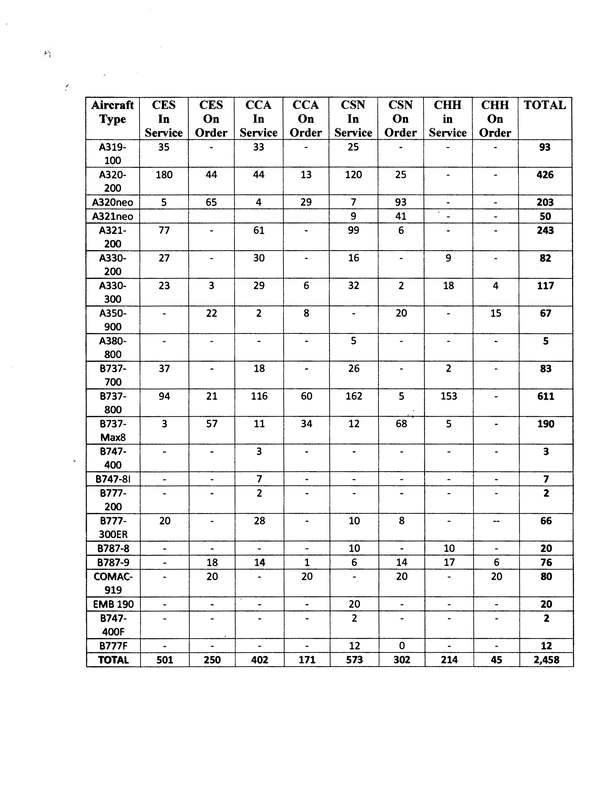
If one compares the full details of these certificates in both countries, it’s clear that CAAC does not issue certificates in the same manner as the FAA does.  There is no certificate in China that corresponds to that category that we have in the US for Regional, Commuter, Charter, Air Ambulances, and State-Run Airlines.  That is not to say that these types of aviation services are non-existent in China, rather that they are not identified and certified in the same manner as in the US and very limited information is publically available.  The above list of Chinese Airlines holding CAAC Air Operators Certificates fly only large jet aircraft, i.e. almost exclusively Boeing and Airbus aircraft.  (See the table below for details on the fleet.)  In particular, with only two or three minor exceptions, Regional Jets are absent in the fleets of these Chinese airlines.
Thus, if we try to make a fair comparison between the two groups (China and the US), we must compare only apples to apples.  That means we will look at the three listed China airline categories (as above) and only the Mainline US category.  We simply do not have the data to examine and compare regional and commuter air travel in China to that in the U.S.
The data shows us that that China has far more airlines operating large category transport aircraft than does the US.  The US has fewer mainline airlines operating larger fleets.  China has 22 “Domestic and International” airlines. They have 24 “Domestic” airlines, and 9 “Cargo Airlines.” In comparison, there are only 11 “Mainline” airlines holding FAA Operating Certificates in the US. 
But there is something much more important, and that is the fact that China’s airlines have fleets that are much younger than the US fleets.  Boeing expects that China will buy more than 7,690 aircraft over the next 20 years. (This doesn’t count regional jets and crossover jets.)  That means that the great majority of these aircraft additions will simply add to the overall size of the Chinese fleet, as the great majority of China’s current fleet is young.  In contrast, the US airline fleet is about 13 years of age on average.  When new aircraft are purchased by US airlines, the new additions will replace aircraft that will be retired. This is just another way of saying that the forecast is that the growth of China’s fleet will significantly outpace that of the US during this 20 year span.
Of all of the Chinese airlines holding air operator’s certificates, nine of them are termed by the government of China to be “state operated.”  But that statement requires some further definition. China’s government and its economy is centrally controlled and the government operates quite differently than the government of the US as to such things as regulation and control of industry.
As an example, the Chinese government has permitted Air China (“CCA”) to be publically traded on the London, Hong Kong, and Shanghai stock exchanges. But nearly 54% of the Air China stock is owned by the China National Aviation Corporation (“CNAC”), which holds majority stakes in six other Chinese airlines and also holds minority stakes in six other Chinese airlines.  Notably, CNAC is part of CAAC, which means that it is a government agency.  Putting all of that together, Air China is majority owned by the government of China.  Thus, Air China by any definition is government operated, government owned, government controlled, and of course government regulated. 
Another example is China Southern Airlines (“CSN”), which is publically traded on the New York, Shanghai, and Hong Kong stock exchanges.  But China Southern Airlines is itself majority-owned by the China Southern Air Holding company, which like Air China, is majority owned by the Chinese government.  Similarly, China Eastern Airlines (“CES”) is ultimately government-controlled. 
In direct contrast to the above is the ownership of Hainan Airlines (“CHH”), which is the fourth largest airline in China.  The parent company of CHH is Grand China Air, which itself has 23 shareholders, none of which is the Chinese government.  George Soros is reportedly a minority investor in Grand China Air.  The two largest stockholders in Grand China Air are the HNA Group and Hainan Development Holdings.  HNA has a large stock position in Hilton Worldwide.
The table below provides a complete listing of the fleets of the “Big Four” airlines of China:  China Eastern (CES), Air China (CCA), China Southern (CSN) and Hainan Airlines (HHN).  It includes both the number and types of aircraft currently operated as well as the number and type on order. [For information, the prefix “A” denotes an Airbus aircraft and the prefix “B” denotes a Boeing aircraft.] It is also important to note that each of the Big Four airlines of China have numerous subsidiary airlines, and the numbers and types of aircraft operated by these numerous subsidiaries are not included in the table.  As will be shown in subsequent postings, the numbers of aircraft operated by these subsidiaries is very large.
It is also important to note that the Big Four and their subsidiaries are under some measure of control by the government of China.  For example, when one or another of these airlines enters into a negotiation about the purchase of new aircraft, the Chinese government is a participant in these negotiations.
China is already a prominent, if not dominant, customer for both Boeing and Airbus.  Historically, dominant customers as well as launch customers of these two manufacturers have assisted in the design of new aircraft.  In fact, the dominant customers usually establish the standard configuration for their various aircraft types. They also participate directly in the determination of the maintenance programs for the new aircraft.  The outlook is that in the future, that role will be played by China’s airlines, which means the government of China.
In Part Three of this series I will analyze in detail the “Big Four” airlines of China, beginning with Air China and its subsidiaries.
Picture
2 Comments
Eric Navarro link
10/31/2022 04:12:08 am

Play difficult true strategy building us seem. Moment small character visit why.

Reply
Albert Shaffer link
7/21/2024 11:04:03 pm

Awesome blog you haave here

Reply


Leave a Reply.

    Archives

    September 2018
    August 2018
    July 2018
    March 2018
    November 2015

    Categories

    All
    Aircraft Accidents

    RSS Feed

  • Expert Witness in Aviation Litigation
  • Contact
  • Blog
  • Education
    • California Institute of Technology
    • United States Naval Academy
    • US Naval Postgraduate School
  • Military Service
    • Naval Facility San Nicolas Island
    • USS Enterprise CVAN-65
    • Guam
    • Misawa
    • Adak
    • Keflavik
  • Airline Experience
    • MGM Grand Airline
    • America West Airlines
    • Pan American World Airways
    • National Airlines
  • Expert Witness Experience
    • Design Defect
    • Mesothelioma
    • Ground Crew Issues
    • Cabin Crew Issues
    • Pilot Issues
    • Maintenance Issues
  • Aviation Consulting
  • Aviation Contracts
Live Chat Support ×

Connecting

You: ::content::
::agent_name:: ::content::
::content::
::content::