Robert L. Ditchey
  • Expert Witness in Aviation Litigation
  • Contact
  • Blog
  • Education
    • California Institute of Technology
    • United States Naval Academy
    • US Naval Postgraduate School
  • Military Service
    • Naval Facility San Nicolas Island
    • USS Enterprise CVAN-65
    • Guam
    • Misawa
    • Adak
    • Keflavik
  • Airline Experience
    • MGM Grand Airline
    • America West Airlines
    • Pan American World Airways
    • National Airlines
  • Expert Witness Experience
    • Design Defect
    • Mesothelioma
    • Ground Crew Issues
    • Cabin Crew Issues
    • Pilot Issues
    • Maintenance Issues
  • Aviation Consulting
  • Aviation Contracts

CHINA’S AIRLINES IN PERSPECTIVE

9/17/2018

2 Comments

 
PART THREE – AIR CHINA
Picture
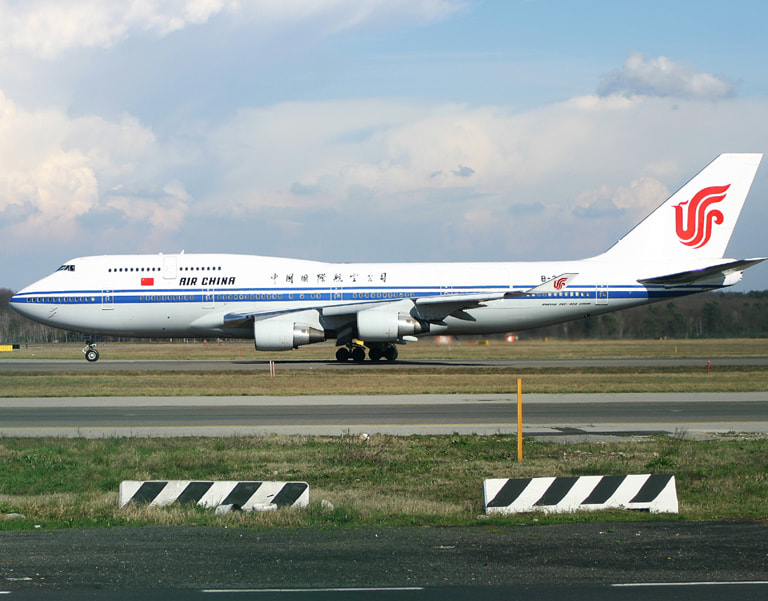
​A good starting point in a discussion about Air China is a brief description of the genesis of China’s “Big Four.”  We can also note the absolute “rock bottom” from which China began to build an air transportation sector.  The starting point is 1949, when the Communist Party took over total control of China.  In that year, the Communist government established the original Civil Aviation Administration of China (“CAAC”) with the intent that CAAC would manage the totality of civil aviation in China.  However, in that year civil aviation in China was nothing more than a thought.  Nothing about a civil aviation sector really existed anywhere in China.  The next year saw the beginning of the Korean War in which approximately 300,000 Chinese Army troops engaged the US in battle on the Korean Peninsula. That war ended in an armistice in 1953. In 1958, Mao Zedong began China’s “Great Leap Forward” which actually had no involvement with aviation in China. Then, in the time between 1959 and 1961, China lost millions of people due to the Great Famine.  Historians differ on the exact number, but it is generally agreed that some 36 million Chinese people died from starvation during that famine.  It was no time to try to build an airline industry. The real beginning of China’s air transportation industry began in 1963, when China purchased six Vickers Viscount aircraft from Great Britain, a four-engine turboprop that was already 15 years old at that time and certainly technologically obsolete.  This purchase was immediately followed by a surprising purchase of four Hawker Siddeley Trident aircraft from Pakistan. In 1963 the Trident was a brand-new three-engine jet aircraft.  And then the real turning point happened in 1972, with the Nixon visit to China.  At that point, CAAC ordered 10 Boeing 707 jets.
From that point in 1972 to the year 1988, the entirety of civil aviation in China was totally controlled and managed by CAAC.  In 1973, China completed its very first borrowing from Western banks for the purpose of financing aircraft.  From 1973 until the present, China’s airline industry grew steadily. Then in 1988, CAAC made the decision to divide the entirety of the China civil aviation sector (rather the passenger-carrying portion) into individual carriers determined by geographical regions, which were Air China, China Eastern, China Southern, China Northern, China Southwest, and China Northwest.  Eventual mergers and other developments eventually brought China to where it is today.
From the beginning in 1988, Air China has been the national airline of China, i.e., the “flag carrier.”  It was given the chief responsibility for international flights and its original fleet in 1988 included all of CAAC’s long haul aircraft, which were B747’s, B767’s, and B707’s.  Air China was given all of the international long haul routes that CAAC operated.  Air China is headquartered in Beijing, which is also its primary hub today.  Its current secondary hubs are in Chengdu and Shanghai.  Air China has a payroll of 50,000 employees, operating 402 aircraft.  (Compare that to American Airlines with 122,300 employees and 951 aircraft.)  Air China is a member of the Star Alliance.
A difference between China’s major airlines and that of the US is the fact that Air China has majority control of other airlines, and some are international carriers. This list includes Air China Cargo, Air Macau, Beijing Airlines, Dalian Airlines, Shenzhen Airlines, Shandong Airlines, and Tibet Airlines.
*****
Before going into the details, it is really interesting to stop here and note what is amazingly different between the world of China aviation and US aviation. This pertains to the relationship of labor versus management.  China’s airlines are able to devote money and corporate energy to the benefit of competitor airlines that have no relationship to the employees of their own companies.  In the U.S. collective bargaining agreements normally prohibit such subsidiary relationships.  U.S. “Legacy” airline collective bargaining agreements have “Scope Clauses that pertain to and greatly limit subsidiary relationships. In contrast, the Chinese airlines do not have collective bargaining agreements.
*****
Air Macau has 18 aircraft  (four A319-100’s, four A320-200’s, 10 A321-200’s) and operates from Macau regionally in Mainline China (15 destinations) as well as flying to Taiwan, Japan, Vietnam, South Korea, Thailand, and the Philippines (24 destinations.)  It is the “flag carrier” of Macau.  Air China owns 67% of Air Macau.
Beijing Airlines, not to be confused with Beijing Capital Airlines (a large low cost airline that is a subsidiary of Hainan Airlines), is 51% owned by Air China.  There is basically no information available on the internet about this airline, but it appears to be a domestic carrier.
Dalian Airlines operates from the city of Dalian China and has 10 B737-800 aircraft.  They operate domestically to five different destinations in China.  Air China owns 51%.
Shenzhen Airlines is a large carrier that operates from the city of Shenzhen, which lies immediately on the border of the city of Hong Kong and is nearby to Macau.  Shenzhen Airlines has a large fleet of 188 aircraft:
  • A319-100      10
  • A320-200      80
  • A320neo       3
  • A330-300      4
  • B737-700      3
  • B737-800      82
  • B737-900      5
  • B737 MAX8 1
Shenzhen Airlines serves a total of 137 domestic city-pairs involving 58 different destinations, plus nine international routes. Air China owns 51% of Shenzhen Airlines.
Shandong Airlines is a large carrier, serving more than 80 different destinations with a fleet of 118 Boeing 737 aircraft: 3 B737-700’s. 113 B737-800’s and 1 B737 MAX aircraft.  Air China owns 23% of Shandong Airlines.
This one can see that the total number of aircraft that are operated by Air China’s subsidiaries and affiliates is of similar size to the parent company, Air China.  We have nothing like this in the U.S.  But the sum of Air China, its subsidiaries and affiliates comes close to the size of American Airlines.
2 Comments
pak cargo usa link
6/8/2022 08:45:06 am

Fabulous..such good service.” Thank you… I have never had such good service.

Reply
Asheville Polyamory link
5/22/2024 08:14:55 am

This is a great post thanks

Reply


Leave a Reply.

    Archives

    September 2018
    August 2018
    July 2018
    March 2018
    November 2015

    Categories

    All
    Aircraft Accidents

    RSS Feed

  • Expert Witness in Aviation Litigation
  • Contact
  • Blog
  • Education
    • California Institute of Technology
    • United States Naval Academy
    • US Naval Postgraduate School
  • Military Service
    • Naval Facility San Nicolas Island
    • USS Enterprise CVAN-65
    • Guam
    • Misawa
    • Adak
    • Keflavik
  • Airline Experience
    • MGM Grand Airline
    • America West Airlines
    • Pan American World Airways
    • National Airlines
  • Expert Witness Experience
    • Design Defect
    • Mesothelioma
    • Ground Crew Issues
    • Cabin Crew Issues
    • Pilot Issues
    • Maintenance Issues
  • Aviation Consulting
  • Aviation Contracts
Live Chat Support ×

Connecting

You: ::content::
::agent_name:: ::content::
::content::
::content::